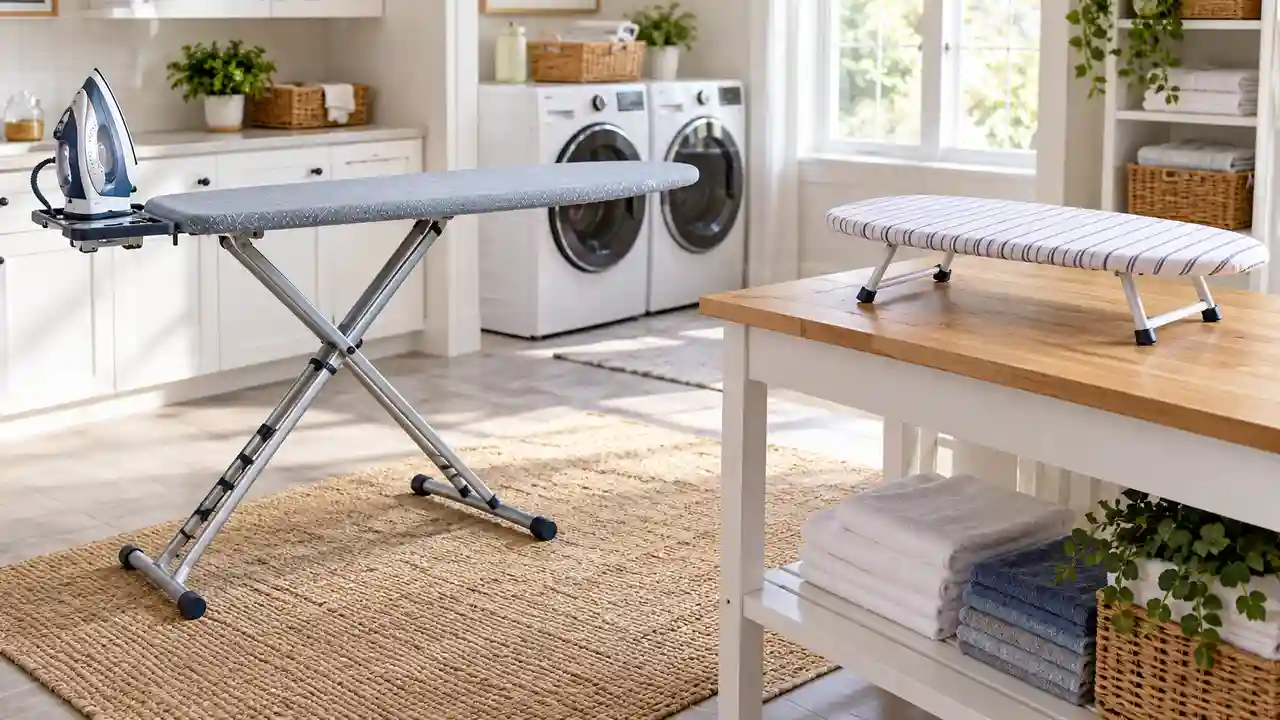
Choose an ironing board by checking its stability, usable height, pressing-surface shape, and compatibility with your iron or steam generator. Then measure where it will be used and stored. A board that is easy to carry but awkward to work at—or large enough for bedding but impossible to put away—is not a good fit for the routine.
Our ironing board comparison can help narrow the equipment choices once you have established the height, support, and storage requirements explained below.
Start With Your Appliance and Regular Laundry
A handheld iron and a separate-tank system place different demands on the support area. Check the rest or tray against the appliance’s actual dimensions and documented compatibility. Do not assume a small metal rest can hold a filled steam generator just because both products are used for ironing.
Next, identify the items you press most often. Shirt sleeves and trouser legs benefit from access around a narrow end. Larger linens and fabric lengths need space to spread and reposition the material. A wider board may reduce repositioning but also require more storage and a larger working area.
For sewing, consider whether you need to place a partly assembled project flat without letting its weight pull from the edge. The longest board is not necessarily the most useful if its shape leaves your common pieces poorly supported.
Check Stability in the Working Position
Look at the leg arrangement, feet, locking mechanism, and how the board stands on your actual type of floor. Inspect for rocking, looseness, or a tendency to tip when the garment is repositioned. A broad base is only useful when the board can sit properly in the space available.
Operate the opening and adjustment mechanisms as directed. A positive lock matters more than the number of advertised positions. Do not use an unstable board simply because you plan to press lightly, and do not treat a board as a shelf for unrelated loads.
Measure Height With Your Working Posture in Mind
Check the usable minimum and maximum heights, not the folded height. If possible, assess the surface while making the movements you normally use: standing or sitting, reaching a sleeve, and parking the iron.
The aim is a position that does not require repeated shoulder lifting, hunching, or reaching across the board. There is no single number that suits every person and task. A seated setup also needs appropriate chair height and clear space beneath the board.
Brabantia’s board-selection guidance discusses checking height adjustment and appliance support. Use the exact product’s specifications to confirm its range rather than transferring another board’s dimensions.
Choose the Format That Fits the Room
| Format | What to Check | Main Trade-Off |
|---|---|---|
| Freestanding folding board | Working height, leg clearance, folded footprint | Versatile positioning but must be carried or stored |
| Tabletop board | Secure feet and a suitable supporting surface | Compact storage but dependent on table height and space |
| Wall-mounted board | Approved mounting and full opening clearance | Convenient location but fixed working position |
| Over-the-door design | Door fit, support, and opening clearance | Uses existing space but depends on door compatibility |
| Cabinet pull-out | Internal dimensions, slide clearance, installation requirements | Discreet storage but requires a compatible cabinet |
When comparing tabletop ironing boards, check the height of the finished pressing surface after adding the board to the table. A compact board does not fix a table that is too high, too low, unstable, or unsuitable for the heat and moisture involved.
Look Beneath the Cover
The deck, padding, and cover work together. Check that the surface feels even and the cover stays securely tensioned without obstructing adjustment parts or rests. Too little effective padding can allow impressions from the structure underneath, while simply adding more layers can change fit and steam behavior.
Check what the manufacturer says about steam handling, replacement covers, and cleaning. A thick-looking cover is not evidence that the setup is appropriate for a high-output system. A wet cover or condensation problem needs investigation of compatibility and use, not an automatic extra layer.
Measure Storage and the Route to It
Record folded length, width, and depth separately. Include projecting feet, handles, trays, or hooks. Check whether the board can pass through the cupboard opening and whether you can lift it without catching its frame on surrounding objects.
Our lightweight ironing board guide is relevant if carrying the board is a frequent part of your routine. A lightweight board may be easier to move, but the weight figure should not replace a stability check. Conversely, a heavier board may work well in a permanent station but become inconvenient if you must carry it upstairs for every session.
Decide What You Need to Pay For
Prioritize a stable mechanism, a suitable height range, appropriate appliance support, and a surface large enough for your common tasks. Treat accessory shelves, cord holders, and storage hooks as useful only when they solve a problem in your setup.
Before buying, check the availability and sizing of replacement covers, the installation requirements where applicable, and the product’s care instructions. A board that continues to fit your routine after its first cover wears out can be more useful than a feature-heavy model with awkward maintenance.
