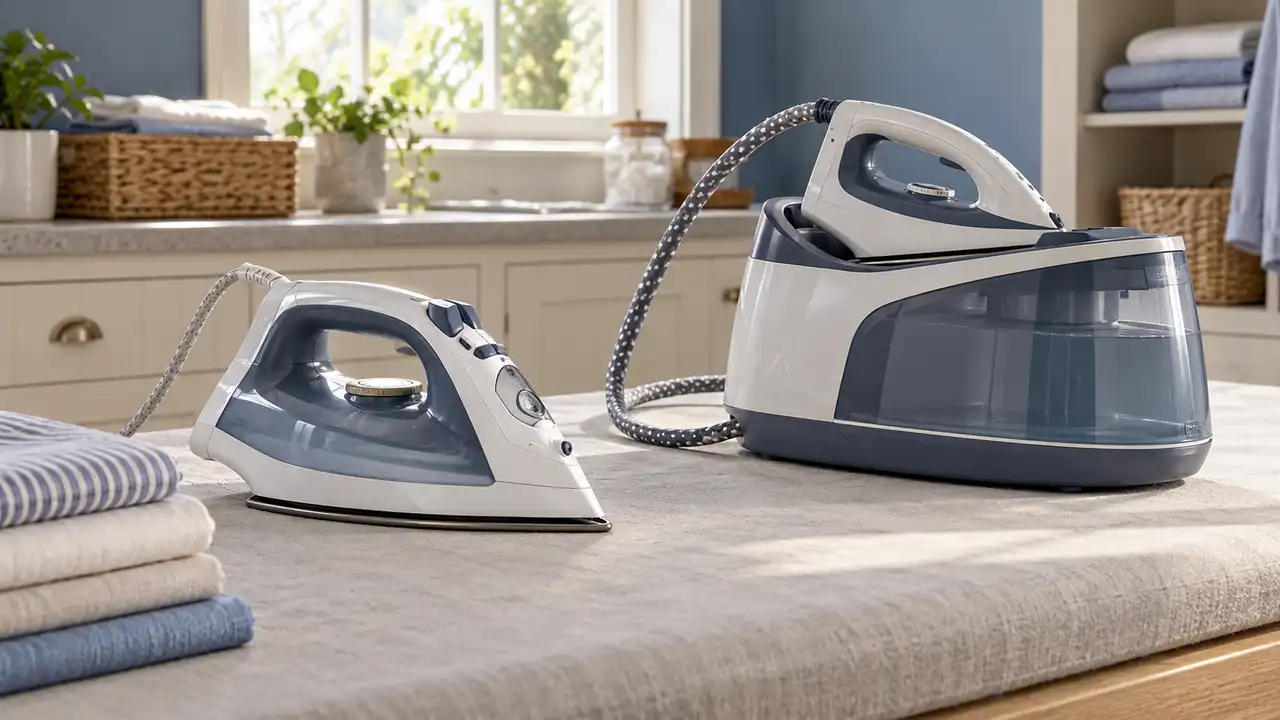
A conventional steam iron keeps its water supply in the handheld body. A steam generator system separates the iron from a larger base connected by a hose. That difference changes filling, handling, storage, and maintenance. A separate-tank system may suit sustained pressing, while a conventional iron is often easier to set up for a small job.
To compare actual equipment after deciding which format fits your routine, see our guides to steam generator irons and conventional steam irons.
Check the mechanism as well as the name. Manufacturers use terms such as steam station for different designs; an external reservoir alone does not prove that a system uses a pressurized boiler.
What Changes When the Tank Moves Off the Iron?
The separate base gives the system room for a reservoir and, in some designs, a boiler. The handheld section and the base perform different roles, joined by a hose that must be managed around the work.
With a conventional iron, you move the reservoir’s water whenever you lift the appliance. With a separate base, more of the system stays on the supporting surface. However, that does not prove every generator’s iron is lighter or more comfortable. Compare the actual handheld weight, grip, hose stiffness, and parking arrangement.
The whole system is usually a different storage proposition. An iron that fits in a narrow cupboard may be much easier to put away than a base, hose, and handheld unit that must cool and be secured together.
Compare the Entire Session
| Consideration | Conventional Steam Iron | Separate-Tank System |
|---|---|---|
| Quick setup | Fewer pieces to position | Requires a suitable place for the base and hose |
| Refilling | Depends on the handheld reservoir and instructions | A larger reservoir may reduce interruptions; refill rules still vary |
| Handling | Water moves with the iron | Base stays in place; hose affects movement |
| Storage | Often compact | Must accommodate the complete system |
| Maintenance | Model-specific tank and soleplate care | May also involve boiler or anti-scale-component maintenance |
When a Generator Can Be Worth the Extra Setup
A long run of shirts, fabric yardage, or household linens can make interruptions more noticeable. If a suitable system reduces repeated refilling and delivers the steam your work needs, its base may be worth setting out.
Consider the length of an ordinary session rather than the most demanding job you might do once a year. A large appliance is not automatically useful when you mainly touch up one item before leaving home. Storage and setup can outweigh capacity you rarely use.
Also remember that strong steam does not eliminate positioning. You still need to arrange layers, avoid unwanted folds, observe fabric-care restrictions, and select the right controls. More steam is not permission to expose every material to more moisture or heat.
Why Pressure and Power Figures Need Context
A pressure figure, a burst-output claim, and a continuous-output figure describe different aspects of a system. They should not be combined into a homemade performance score. Check the documented measurement and operating mode before comparing products.
Check whether the exact system uses a pump, a separate boiler, or another documented arrangement. An external reservoir and a product-category name do not establish how steam is generated or delivered.
Your Board Must Support the Base
Our guide to ironing boards for steam generators addresses supporting-surface choices. Check the holder’s dimensions and documented load compatibility with the system, including its filled condition. A small rest designed for a handheld iron should not be assumed to accommodate a generator.
Position the hose so it does not pull the base toward an edge or catch on the garment. Leave the clearance required by the instructions, and use a stable surface that the appliance manufacturer permits. Do not improvise support by balancing a base on a folded chair or an undersized shelf.
Steam also has to move through the board and cover appropriately. If moisture accumulates, investigate the cover’s suitability and the operating instructions rather than assuming extra padding will solve the problem.
Hard Water Does Not Have One Universal Solution
Check the exact system’s water instructions before choosing a water source or treatment. Different appliances can specify different water types and maintenance routines. An anti-scale label does not mean that cleaning is unnecessary or that any descaling liquid is acceptable.
A boiler may also have requirements that do not apply to a removable cold-water reservoir. Never loosen a cap or open a maintenance point while the system is hot or pressurized. Follow the manual’s cooling and servicing process, not a general internet recipe.
Make the Decision Around Frequency and Space
A conventional iron is a practical starting point when portability, simple storage, and occasional sessions dominate. A separate-tank system becomes more attractive when repeated, sustained pressing justifies a dedicated setup.
Before switching, measure the storage area and supporting tray, read the maintenance instructions, and consider whether the hose and base improve your normal routine. The larger system is useful when its working advantages are greater than the extra setup it brings.
