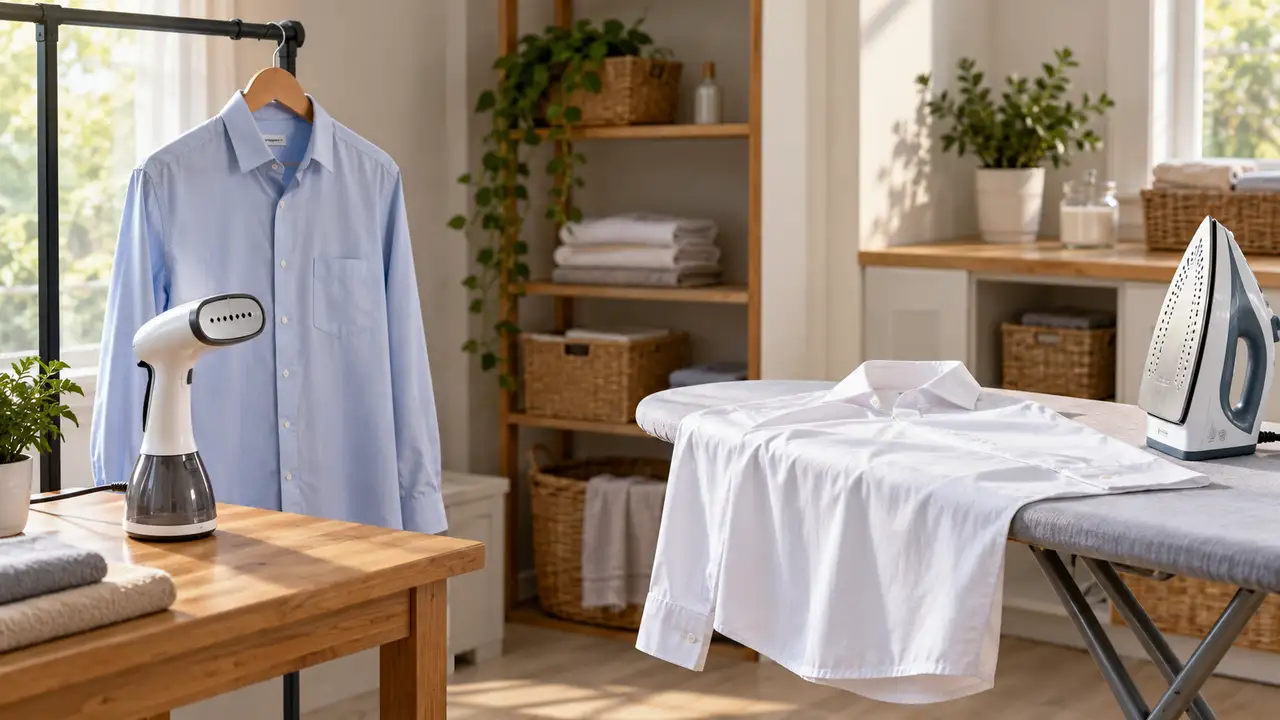
A clothes steamer is useful for relaxing wrinkles while a garment hangs; an iron gives you a heated surface and pressure for smoothing fabric and forming deliberate creases. Choose between them by the finish you need, the garment’s care instructions, and the space available—not simply by which appliance has the higher wattage.
If you are choosing equipment after comparing the methods, our steam iron comparisons and clothes steamer guide focus on the appliances suited to each approach.
For a softly finished blouse or a quick outfit refresh, a steamer can be convenient. For a crisp shirt collar, a flat seam, or sharply creased trousers, an iron usually offers more direct control. Neither method is suitable for every garment.
What Each Tool Does to the Fabric
An iron places its soleplate against the garment. Temperature, moisture where permitted, and the pressure you apply work together. A board or another suitable pressing surface supports the fabric underneath, allowing you to position small areas accurately.
A conventional garment steamer directs steam toward fabric rather than relying on pressure between a hot soleplate and a board. The garment’s weight and careful positioning help it hang smoothly. This makes it useful when you want fewer wrinkles without deliberately flattening the garment’s structure.
The boundary is less clear with combination appliances. Some steamers have heated plates designed for approved contact use, and some systems include a supporting board. Check the actual operating instructions rather than assuming that everything called a steamer works without contact or that every steam head can be used like an iron.
Compare the Finish Before Comparing Convenience
| Task | Iron | Garment Steamer |
|---|---|---|
| Crisp collars and cuffs | Offers localized heat and pressure | Can relax wrinkles but does not provide the same supported pressing action |
| Deliberate trouser creases | Allows careful alignment and pressing | Ordinary hanging steaming is not the same as setting a crease |
| Quick refresh of hanging clothes | Often requires setting up a surface | Can work with a suitable hanger and clear working space |
| Quilt seams | Supports controlled pressing on a flat surface | Does not replace supported seam pressing |
| Garments with trims or special finishes | Requires label-specific precautions | Also requires label-specific precautions |
When an Iron Fits the Job
Use an iron when the result depends on precise positioning. A pointed soleplate can reach a collar edge or work around buttons, while the supported board lets you smooth one layer without unintentionally pressing folds into another.
It is also the more relevant tool for construction work such as pressing seams during sewing. Here, the objective is not merely to remove visible wrinkles. You may need to establish a fold or flatten a seam allowance without dragging a partly assembled piece out of shape.
The trade-off is setup and handling. You need an appropriate work surface, room to move the garment, and a safe place to park the hot iron. A heavy iron may feel tiring when repeatedly lifted, even if it glides comfortably once it is resting on fabric.
When a Steamer Fits the Job
A steamer can suit clothes that need a softer finish or are awkward to arrange over a board. Hanging fabric leaves fewer layers to reposition, and the steam head can follow larger sections without laying the whole garment flat.
That convenience depends on the setup. You still need a stable hanging point, clearance behind the garment, access to an outlet, and a place to put the hot appliance. A handheld unit also becomes a filled weight in your hand. “No ironing board” does not mean “no working space.”
Do not assume steam is automatically safe for delicate items. Lining, dye, pile, coatings, and glued decoration can matter as much as the main fiber. Follow the garment’s care directions, and do not use a hidden-area test to overrule an explicit restriction.
Consider Your Actual Routine
If you regularly press work shirts and sew, an iron is likely to handle more of your essential tasks. If you mainly refresh a small number of hanging outfits, a steamer may be easier to incorporate into your routine. A household can reasonably use both, but owning both is not a requirement.
Before adding another appliance, identify what your current method fails to do. Is the problem a lack of creasing control, difficulty hanging clothes, repeated tank refills, or inconvenient storage? Each problem points toward a different feature. Buying a second device without identifying that gap can leave you with two tools that are equally awkward to use.
Keep the Care Instructions in Control
Check both the appliance manual and garment label. A steam iron’s vertical-steam mode is not permission to use its soleplate on every hanging garment; a steamer’s heated plate is not permission to press every fabric. Never treat clothing while someone is wearing it.
Use the instructions for your own appliance to decide which operating modes it supports. In particular, check whether the head is designed for contact with fabric or for use in a particular orientation.
